What Is the GAT? How I Scored a Study Score of 50 in the Writing Section
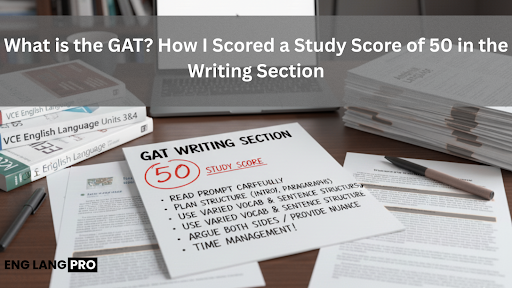
Many VCE students ask the same questions every year: What is the GAT? Why does it matter? How does the writing task work? And what does it take to perform at a high level?
If you’re studying VCE English Language, this guide will not only explain the definition of the GAT, the GAT 2025 structure, and what the VCAA GAT is used for, but it will also give you a clear, practical approach to succeeding in the writing section, informed by how I achieved a study score of 50.
1. What Is the GAT?
The General Achievement Test (GAT) is a compulsory, statewide assessment for all students enrolled in one or more VCE or scored VET Unit 3–4 sequences.
When students ask “What is the GAT used for?”, the answer is simple:
it helps the VCAA verify the accuracy of your school-based assessments, exam performance, and statistical moderation.
Here is the definition of the GAT in simple terms:
The GAT is a skills-based assessment that measures your general literacy, numeracy, reasoning ability, and communication skills. It is not tied to any single subject but supports fair and accurate scoring across all VCE studies.
Even though the GAT does not directly give you a study score, it is an essential component of the VCE system. If an exam is disrupted, if there are authentication doubts, or if statistical moderation is required, your VCE GAT results help maintain fairness.
2. The GAT 2025 Structure: What’s Changing?
The GAT 2025 continues the two-section format introduced in recent years, but with further clarifications on expectations.
Section A — Literacy and Numeracy
Covers:
Reading comprehension
Mathematical reasoning and numeracy skills
Interpreting charts, tables, and data
Section B — Writing & General Reasoning
This is where English Language students shine.
Section B includes:
A writing task (extended response)
Analytical and reasoning-style questions
A text-based or issue-based prompt
The writing task tests your ability to:
Communicate effectively
Organise ideas logically
Use appropriate tone, register, and structure
If you’re studying VCE English Language, this section aligns closely with skills you already practise: analysing context, shaping register, using metalanguage, and constructing coherent arguments.
3. What Is the GAT Used For? Why It Matters More Than You Think
The VCAA GAT is used to:
✔ Validate your exam performance
If your exam score is significantly higher or lower than expected, your GAT can verify your ability level.
✔ Support Derived Examination Scores (DES)
If illness, an accident, or unexpected circumstances prevent you from sitting an exam, your GAT performance supports your DES.
✔ Assist with statistical moderation
The GAT helps ensure fairness across different schools and cohorts.
This is why looking at past GAT papers is useful, they show the consistent skills VCAA assesses.
Even though the GAT does not contribute directly to your ATAR, a strong performance provides a reliable safety net.
4. How to Score 50 in the Writing Section
When I sat the GAT, I didn’t treat it as “just a practice exam”.
I treated the writing section as an opportunity to showcase:
clarity
organisation
tone control
analytical thinking
Here’s the truth:
You don’t need to write creatively. You don’t need to be original. You need to be precise.
I focused on three things:
1. Understanding the prompt deeply
I spent 3–4 minutes unpacking the exact wording.
This made my response sound intentional and disciplined.
2. Structuring with absolute clarity
I followed a simple three-part structure:
introduction
body (2–3 ideas)
conclusion
This kept the writing clean and purposeful.
3. Writing in controlled, confident Standard Australian English
English Language students often overcomplicate expression.
The winning approach is simple:
Clear, concise, precise writing always scores highest.
And that’s exactly what we’ll break down next.
5. How to Excel in the GAT Writing Task (Step-by-Step Guide)
The writing task in the GAT test Victoria is primarily a communication-based task. You won’t be asked to recite linguistic metalanguage, but your English Language training gives you an advantage.
Below is the strategy that consistently produces high-scoring writing.
Step 1: Analyse the prompt
Ask:
What is the issue?
What is the central message?
What type of text am I expected to produce?
Who is the audience?
Even for a general essay-style task, audience + purpose + tone matter.
Step 2: Plan a 3-part structure
Introduction
Paraphrase the question
State your main contention
Preview the 2–3 key points
Body paragraphs
Each paragraph should include:
A clear topic sentence
Evidence from the stimulus
Explanation
A link back to the prompt
Conclusion
Reaffirm your position
Summarise the ideas
Leave a final cohesive impression
Step 3: Control your tone and register
Your writing must:
Use Standard Australian English
Maintain a formal or semi-formal tone
Avoid slang, contractions, and unnecessary complexity
This is where VCE English Language students excel. You already understand how register, purpose, and context shape meaning.
Step 4: Prioritise clarity over style
High-scoring responses:
use short paragraphs
avoid flowery language
maintain logical sequencing
stay tightly relevant
This is exactly how markers differentiate a 30-level response from a 50-level one.
6. Tips for English Language Students
If you’re studying VCE English Language, you already have the tools to excel in the GAT writing section:
✔ Cohesion and coherence analysis
You understand logical sequencing and cohesive devices.
✔ Tone and register control
You can adjust depending on audience expectations.
✔ Purpose-driven writing
You are trained in identifying the function of a text and are a vital part of writing effective responses.
✔ Lexical precision
English Language students write with clarity, not fluff.
7. How to Prepare: Practical Study Tips
• Look at past GAT papers
This shows you how prompts are framed and how stimulus materials are presented.
• Practise timed writing
Aim for 25–30 minutes per response.
• Read high-quality opinion pieces
Not for content, structure, tone, and clarity.
• Use VCE English Language free resources
These reinforce your understanding of text structure, coherence, and purpose.
8. Final Advice: Don’t Stress — Prepare Smartly
The GAT is not a memorisation test.
It’s a skills test.
When you understand:
What is the GAT?
What is the GAT used for?
How does the GAT 2025 writing task work?
…you can walk in confident and calm.
And if you're already developing strong analytical and writing skills in VCE English Language, you have a built-in head start.
Want Free Resources for VCE English Language?
If you’d like free guides, metalanguage sheets, sample essays, and GAT writing templates, I can generate a complete VCE English Language toolkit for you.
Just Explore: “VCE English Language free resources”
Conclusion
The GAT is an important part of your VCE journey, even if it doesn’t directly impact your ATAR. By understanding the structure, practicing past papers, and staying calm, you can score well on the test. Remember, it’s not about memorizing facts, it’s about demonstrating your general skills in literacy, numeracy, and reasoning. Follow the steps I’ve shared, and you’ll be well on your way to achieving a great result in 2025.